Analysis of the explosion of the ignition coil
1、Sagitar’ignition coil burst
The fault phenomenon:
From customers reaction that the vehicle has severe dithering in the driving, and cannot Accelerate even flameout. Also the ASR anti-slide light up.
Using VAG5052A for querying failure:
Engine electronic system: The first of ignition coil starts the positive terminal gets short circuit.
Brake electronic system: Engine electronic system failure
Electronic power steering system: Engine electronic system failure.
Because they belong to the system on the power line, through the gateway linked together to share the information on the power bus, any part of the bus failure, in other systems will be based on pre-set procedures to record fault information. It is tentatively judged that the failure of the brake electronic system and the electronic power steering system is caused by the engine failure, and the inspection of the engine failure is focused. By the engine fault code, suspect the problem in the ignition coil or its line.
Starting the engine, idle for about 10 minutes, the vehicle has severe dithering in the driving, and cannot speed up even flameout. Also the ASR anti-slide light would light up. And then restart the vehicle, the engine can run normally, with VAG5052 read the engine data stream 14 group, this time the data are normal. Fire memory when failure occurs again. The fault points are judged on the ignition coil, ignition coil line, or engine control unit.
Removing the secondary air pump, and remove the plug of the ignition coil, checking that there is no rust in the plug, measure the four lines of the ignition coil with the multimeter, and the t4/2 has 12V positive, and t4/4 to the computer J361, T121/113 connect normal. The ignition coil was removed and a crack was found at the bottom of the ignition coil, so the ignition coil was replaced and the vehicle was retested. Failure did not occur. The problem seems to be solved, but after a while, the failure reappears! And the engine failed to start.
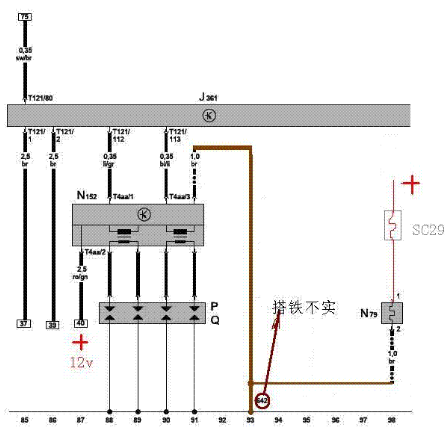
At the station, the ignition coil was found to be explosive again. It seems that the problem is not in the ignition coil, but in the wiring or engine control unit that relates to the ignition coil. Re-examine the line of the ignition coil. (figure 1)
(figure 1)
The second pins of the ignition coil comes from the J363 (power relay of the SIMOS control unit) through the SB14 fuses and produces the 12V positive Voltage. The first and third pins are controlled by J363 (engine control unit), one of the which controls the ignition of a four-cylinder, the second and third cylinders are controlled by the third pins. This is to say, the normal of the engine, when the first check point on the compression, J361 would disconnect, thus induced voltage in the secondary coil of matters cylinder, lit a crock of mixture, a crock of doing work. Measure the first and the third cylinder to J361 line, it shows normal. Reference to the circuit diagram can be seen: the ground line of the ignition coil is also an iron wire of the crankcase, and the one on the N79, and the one on the N79 is from J519, which is the 12V positive charge from the sc-29 fuses. Wechat public motor repair technology services, just thinking, if 642 iron points were not fit, the positive charge of J519 would be connected directly with the fourth stitching of the ignition coil at N79, so that the primary loop of the ignition coil would be blocked and the ignition coil would not be ignited, and the engine control unit J361 would record the ignition coil to the positive terminal short circuit fault. Check the 642 for the iron wire, under the engine air filter, find that the fixed nut of 642 iron point has been loosened. Cleaning up the iron point , reattach and replace with a new ignition coil. In order to verify the failure point, remove the fault code, start the engine, and manually disconnect 642 to the iron point, the fault occurs, and the fault point is found to be loose in 642.